YouTube GEO: how to get your videos cited by ChatGPT, Perplexity, and Google AI
AI answer engines can't watch video, so even definitive YouTube content goes unmentioned. YouTube GEO: how to turn videos into the structured, citable sources AI answers quote.
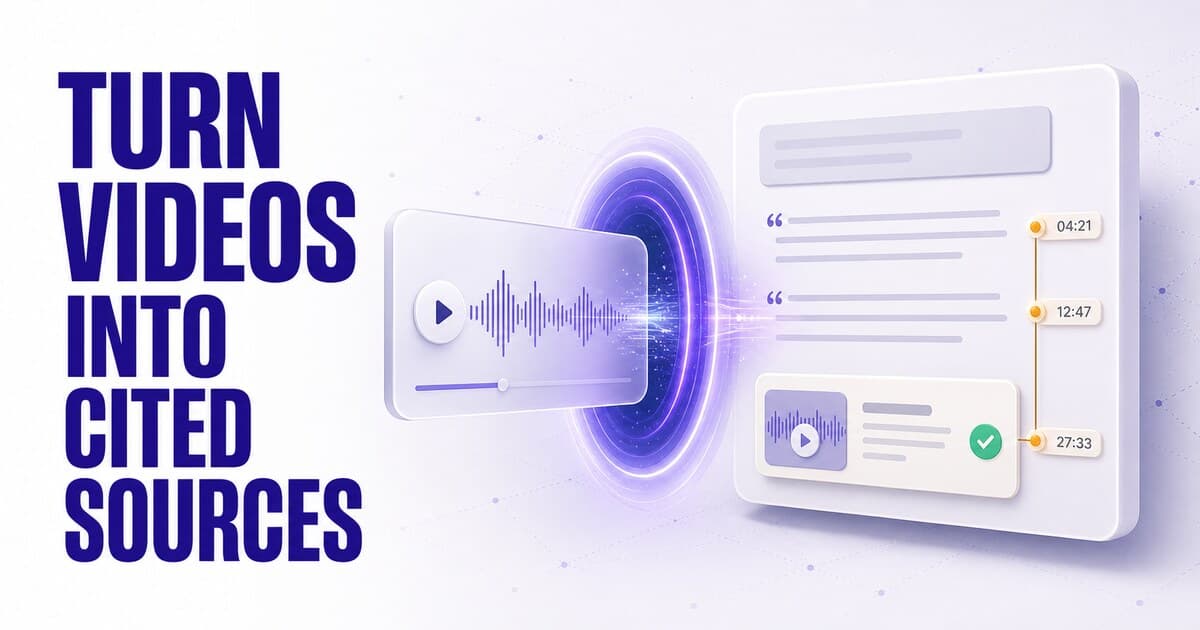
GEO — generative engine optimization — is the practice of structuring content so AI answer engines cite it. For YouTube creators the starting position is brutal: ChatGPT, Perplexity, and Google AI build answers from text they can read, and a video gives them nothing to quote, so the thin blog post gets the citation your video earned. YouTube GEO means giving every video a text twin an engine can retrieve and attribute: a structured page with a grounded summary, key moments as discrete claims, entities, schema markup, and stable timestamped URLs — plus a live MCP endpoint agents can query directly. PodHood builds all of it from one read-only channel connection, and AI-badged referrals in Access Analytics show the citations turning into visits.
Ask ChatGPT or Perplexity a question your channel has answered definitively — the guest who explained it best, the episode that went deepest — and watch what gets cited: a blog post, a documentation page, a Reddit thread. Anything textual. Your video, which said more, isn't in the running.
That's not an authority problem. It's a format problem, and it has a name now: GEO — generative engine optimization — the discipline of structuring content so AI answer engines cite it. This post is GEO for YouTube specifically: why channels start from zero, how retrieval actually chooses sources, what makes video content citable, and how to build the whole pipeline without changing how you publish.
Why answer engines can't cite your videos
An answer engine composes its response from text it can read, retrieve, and attribute. Every citation needs something to point at — a sentence, a claim, a stable URL.
A YouTube video exposes almost none of that. The engine sees a title, a description, some metadata; the ten thousand words of conversation inside are as opaque as the pixels. Even auto-captions don't help — they're a playback aid inside the player, not structured pages an engine can crawl, parse, and quote with attribution.
So the definitive hour you published loses the citation to a five-hundred-word post, because the post is quotable and the video is not. The fix is not making the video better. It's making what the video says exist as text.
How answer engines actually pick their sources
It's worth understanding the mechanics, because they explain every recommendation that follows.
When an engine answers a question, it doesn't reread the whole internet — it retrieves passages: self-contained chunks of text that its index scored as relevant to the question. Those chunks are what get compared, quoted, and attributed. Three properties decide whether a chunk of yours wins:
- Self-containment. A passage that makes sense alone — claim, context, attribution in one place — can be lifted into an answer. A sentence that only works in the middle of a transcript can't.
- Answer-first structure. Top-performing GEO content puts a direct, complete answer at the top of each section rather than building up to it; the first ~200 words of a page do disproportionate work.
- Groundedness. Specific, attributable statements out-cite vague ones. Research from Princeton and collaborators found that adding statistics, quotations, and cited sources lifts AI-citation rates by roughly 30–40% (LLM Pulse).
Now look at a raw transcript through that lens: no sections, no summaries, no attribution markers, no per-passage URLs. Rich material, zero retrievable chunks. That's the gap YouTube GEO closes.
What a citable text twin looks like
Turning a video into a source engines cite takes more than pasting a transcript somewhere. Each layer exists to turn conversation into retrievable, attributable passages:
- A grounded summary an engine can lift whole — the direct-answer block at the top of the page, written from what was actually said rather than around it.
- Key moments as discrete claims, each phrased to stand alone, each with a timestamp URL. Compare the raw caption line — "yeah so I mean for us it was really about that" — with the structured moment: "Sarah Chen: the real unlock was owning the audience relationship — 18:42." Only one of those can be cited.
- Named speakers and entities, so a system knows who made the claim and what the video connects to — the attribution half of a citation, and the disambiguation that lets retrieval find "the episode about distribution moats" from a dozen phrasings.
- Schema.org markup (episode, deep-linkable clips, people) so parsers get the structure explicitly instead of inferring it.
- Stable, crawlable URLs on one domain — ideally yours — so authority accrues somewhere you own, and a citation lands the reader on the exact second rather than the top of an hour.
Here's the same content in its three possible forms:
| Auto-captions | Transcript dump | Structured brief | |
|---|---|---|---|
| Crawlable page | No | Yes | Yes |
| Retrievable in chunks | No | Poorly | Yes — per moment |
| Attributable (who said it) | No | No | Yes |
| Quotable standalone claims | No | Rarely | Yes |
| Deep link per claim | No | No | Yes — to the second |
This is exactly the structured Brief PodHood builds from every video on a connected channel, published as real pages on your domain.
The two roads into an AI answer
Citations arrive through two distinct pipelines, and a serious YouTube GEO setup covers both:
The crawl road. ChatGPT search, Perplexity, and Google AI Overviews retrieve from pages their crawlers have read. PodHood's libraries welcome AI crawlers explicitly — robots.txt admits GPTBot, ClaudeBot, and PerplexityBot; llms.txt indexes the published catalog and the MCP endpoint; every episode ships a Markdown twin (append .md to its URL) for agents that prefer plain text over rendered HTML.
The agent road. Assistants like Claude and ChatGPT can query tools directly over MCP. Every PodHood channel serves its archive as a live MCP endpoint, so an agent doesn't hope a crawler saw your video months ago — it searches your catalog in real time and gets back ranked moments, each with a citation URL to the exact second. How that works in depth.
The roads also differ in tempo, which matters for expectations: crawlers revisit on their own schedule, so the crawl road compounds over weeks; the agent road is live the day an episode indexes.
One more reason to cover both — and every engine within each: citation overlap between engines is remarkably low. One analysis found only about 2% of cited URLs appear across AI Overviews, ChatGPT, and Perplexity at once, with 91% showing up in just one engine (Superlines). Eligibility everywhere is the strategy; betting on one engine is not.
Doing it: the YouTube GEO playbook
- Connect the channel — read-only; nothing about your YouTube workflow changes. Every video becomes a structured page; new uploads join hourly.
- Verify one episode end to end. Open its page signed out, check the Markdown twin, find it in
llms.txt, ask a connected agent a question it answers, and click the citation back to the timestamp. The get found & cited docs walk the full checklist, including Google's Rich Results Test for the schema layer. - Fix what attribution depends on. Misattributed speakers and duplicate entities weaken citations — a claim credited to the wrong person is a claim an engine can't safely quote. Correct them once in the Studio and every surface updates.
- Index a coherent cluster, not scattered episodes. Engines weigh topical authority; five indexed episodes about your core subject build a more citable position than fifty disconnected ones. Start the back catalog with your strongest topic.
- Watch the receipts. Access Analytics badges AI referrers — chatgpt.com, perplexity.ai — and records what agents ask your catalog verbatim. Recurring agent questions you haven't answered yet are next episode's brief, requested directly by the market.
A worked example
A viewer asks Claude: "What did Sarah Chen mean about owning the audience relationship?" On a connected channel, the agent queries your library's MCP endpoint, retrieves the key moment at 18:42 of episode 142 — a discrete, speaker-attributed claim — and answers with a citation that deep-links to that second on your domain. Without the text twin, the same question gets answered from whatever blog post paraphrased the idea, and your episode — the primary source — goes unmentioned. Multiply that by every question your catalog has ever answered; that's the ground YouTube GEO claims.
Honest expectations
No product can guarantee that a given engine cites a given video — PodHood builds the eligible surfaces; engines decide what they retrieve. Two things are true at once: measured AI referral traffic today is a floor (attribution drops on some surfaces), and the direction is one-way — answer engines keep growing, and they keep citing whoever gives them structure. For YouTube conversation content, almost nobody does yet. That's the opening.
Your channel already answered the questions. Make it citable: PodHood for YouTube channels · how citations work · the GEO vs SEO primer.
Frequently asked questions
- What is YouTube GEO?
- Generative engine optimization applied to a YouTube channel: structuring what your videos say so AI answer engines — ChatGPT, Perplexity, Google AI Overviews, Claude — can retrieve, quote, and cite it. Since engines can't watch video, YouTube GEO is mostly about giving each video a structured, machine-readable text twin.
- Why doesn't ChatGPT cite YouTube videos?
- Because an answer engine assembles responses from text it can read and attribute, and a video exposes almost none — a title and description at most. Unless the conversation exists somewhere as structured text with stable URLs, the engine cites a text source that said less, later, with less authority.
- How do I make my YouTube videos citable by AI?
- Publish each video's content as structured text: a grounded summary, key moments phrased as discrete claims with timestamps, named speakers and entities, Schema.org markup, and a stable URL per moment. Then make it discoverable — sitemap, llms.txt, Markdown twins — and, for agents, expose the catalog as an MCP tool they can query directly.
- Do YouTube auto-captions make my videos citable?
- No. Captions are a playback aid inside the player, not crawlable pages: no stable URLs, no structure, no attribution of who said what. An engine needs a document it can retrieve, parse, and point at — which is exactly what captions aren't.
- Does getting cited by AI actually send viewers?
- Increasingly. Some engines tag their outbound links — ChatGPT appends utm_source=chatgpt.com — and others pass referrers, so citation click-throughs are measurable. PodHood's Access Analytics badges those AI referrals, making the pipeline from citation to visit visible; measured AI traffic is a floor, since some surfaces drop attribution.
- How long until AI engines start citing my channel?
- Crawl-based engines need to discover and revisit your pages, so expect weeks rather than days, compounding as more of the catalog indexes. Agent-based retrieval over MCP is immediate — a connected agent can query the archive the day an episode publishes. No product can guarantee a specific citation; the work is staying eligible everywhere.
- Is YouTube GEO different from podcast GEO?
- The mechanics are identical — engines can't hear audio or watch video, so both need the same text twin. The difference is competitive: podcast GEO advice is spreading, while almost nobody is building citable text surfaces for YouTube channels, so early movers face far less contested ground.
- Can I do this without changing my YouTube workflow?
- Yes. PodHood connects read-only, checks the channel hourly, and builds the structured pages, markup, discovery files, and MCP endpoint from each new upload automatically. You keep publishing on YouTube exactly as before.
Founder of PodHood. Writes about how podcasts and YouTube channels get found on Google and in AI answers — and turn that discovery into an audience they own.
Keep reading
- Does your podcast need its own website? Why one platform isn't enough
- WebMCP for podcasts and YouTube channels: now agent-ready