Be the podcast AI cites.
Answer engines can’t listen to audio or watch video — they cite text they can read and trust. PodHood turns your episodes, from YouTube or RSS, into a grounded, queryable source with citations built in — so AI answers about your topics can point listeners back to you.
Engineered for generative answers
GEO is the new SEO. The same structure that gets your episodes quoted in AI answers makes them queryable by agents.
Live MCP endpoint
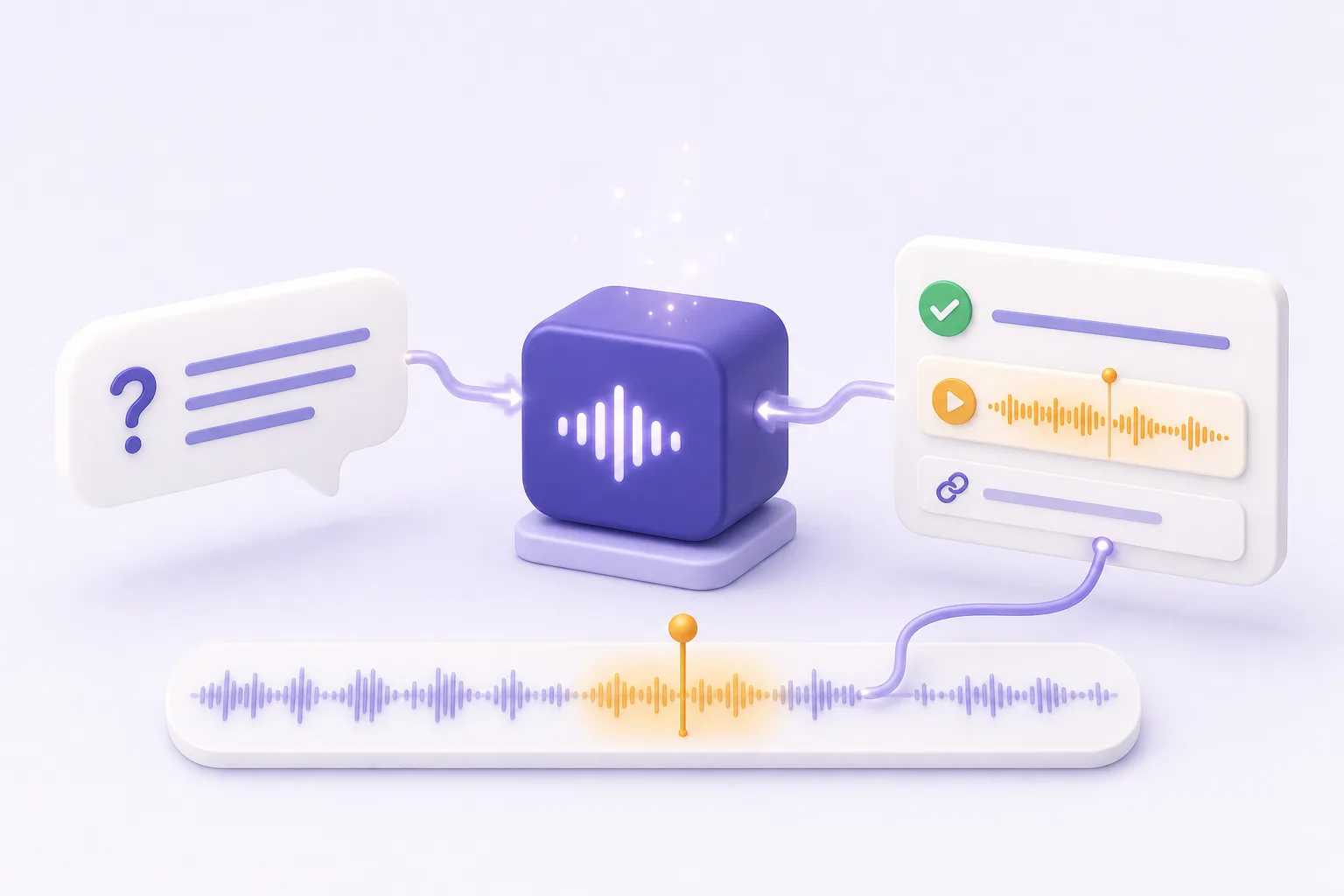
Your whole archive connects to Claude and ChatGPT as a tool — agents query it directly, in real time.
Timestamped citations
Every answer an agent gives from your catalog links back to the exact moment it came from.
Grounded, not guessed
Retrieval over your real Brief — key moments, entities, and quotes — not a hallucinated summary.
Answer-engine ready
Structured pages and markup built for ChatGPT, Claude, and Google AI Overviews to quote as the source.
How do AI assistants choose which sources to cite?
Answer engines cite text they can retrieve, parse, and attribute — not audio. When ChatGPT, Claude, or Google AI answers a question, it pulls from structured, machine-readable pages with clear sourcing. An episode that only exists as an audio file is never in the running.
PodHood puts your catalog in the running: every episode becomes a structured page — summary, key moments, speakers, entities — the exact form retrieval systems extract and quote.
What is generative engine optimization (GEO) for podcasts?
GEO is the practice of structuring content so AI systems cite it when answering questions — the successor discipline to SEO. For a podcast, it means turning spoken conversation into extractable, attributable text: direct claims, clear structure, and markup an answer engine can quote with confidence.
That structure is exactly what the Brief is. Grounded summaries an engine can lift, key moments with timestamps it can link to, and a disambiguated graph of who said what — the difference between being paraphrased anonymously and being the cited source.
What is the MCP endpoint?
MCP (Model Context Protocol) is the open standard that lets AI assistants query external tools. PodHood exposes your entire archive as a live MCP tool, so Claude and ChatGPT can search it directly and answer with grounded, timestamped quotes.
Instead of hoping a crawler picked up your episode months ago, an agent queries your catalog in real time and gets back ranked moments, each with a citation URL to the exact second. Your archive stops being content an AI might have seen and becomes a source it can actually use.
When someone asks an AI a question your podcast already answered, PodHood makes sure your episode is the citation.
Frequently asked questions
Two paths. Crawl-based answer engines — ChatGPT search, Perplexity, Google AI Overviews — read your Library’s structured pages and markup. Agent-based assistants — Claude and ChatGPT — connect to your archive directly over MCP and quote it with timestamped citations.
A link to the exact moment: each key moment and quote resolves to your episode page at its timestamp, so a reader lands on the second the claim was made — on your Library, in your player.
Yes — answer engines can't watch a video any more than they can hear a podcast, so a YouTube-only channel is invisible to them as a source. Connect the channel and every video's conversation becomes structured, citable pages plus a queryable MCP endpoint; citations deep-link back to the exact moment.
Yes. Only published episodes are exposed — through the pages, the sitemap, and the MCP endpoint alike. Your source channel stays the source of truth: curate there, and the Library follows.
No. Retrieval runs over the structured Brief — key moments, entities, and quotes — not a raw transcript dump, so answers come back grounded in what was actually said, with the receipts attached.
The Library is built to be found: robots.txt welcomes AI crawlers like GPTBot, ClaudeBot, and PerplexityBot; llms.txt indexes your published episodes and your MCP endpoint; a sitemap lists every page; and each episode ships a clean Markdown companion — add .md to its URL — for agents that prefer plain text.
Any MCP client. The Library ships a connect dialog with guided install recipes for 30+ agents and tools — Claude, ChatGPT, Perplexity, Cursor, VS Code, and more — plus the raw endpoint URL for everything else.
The Library and its MCP endpoint follow your custom domain on every plan. Studio white-labels both on that domain, so agents see your brand instead of PodHood’s.
Yes. Every Library page also registers in-page WebMCP tools, so an agent browsing alongside a visitor — in the ChatGPT desktop app, or Chrome’s WebMCP origin trial — can search your catalog, filter the episode list, read the transcript, and play a moment, right on the page with no setup. It complements the MCP endpoint, which serves agents connecting from outside.
Grow from episodes you’ve already made.
Connect a YouTube channel or podcast feed — your back catalog imports in minutes, and every episode becomes another way for new listeners to find you. Free to start — no credit card.
Get started